Brickell's Best New Table Isn't on the Sidewalk Anymore
October 1, 2026
October 1, 2026
Walk down South Miami Avenue on a weeknight and you won't see the restaurant everyone in Brickell has been talking about since March. It's fifty-four floors above you, reachable only by an elevator bank inside an office tower that also houses Microsoft, Citadel, and Kirkland & Ellis. A few blocks east, across the bridge onto Brickell Key, a stretch of waterfront that spent nearly a year without a proper dinner spot finally has one again, and it opened the same month the island's old five-star hotel came down in a controlled implosion visible from boats out on the bay.
That's the shape Brickell's dining scene has taken this year. The neighborhood's most talked-about new restaurants aren't winning customers off the sidewalk. They're opening inside buildings that already have people in them, whether those people are tenants riding the elevator to a client dinner or residents of an island with exactly one place left to eat. Meanwhile, the restaurants still trying to make it on scarce street-level ground are running into rent, litigation, and zoning fights that the tower restaurants never have to face at all.
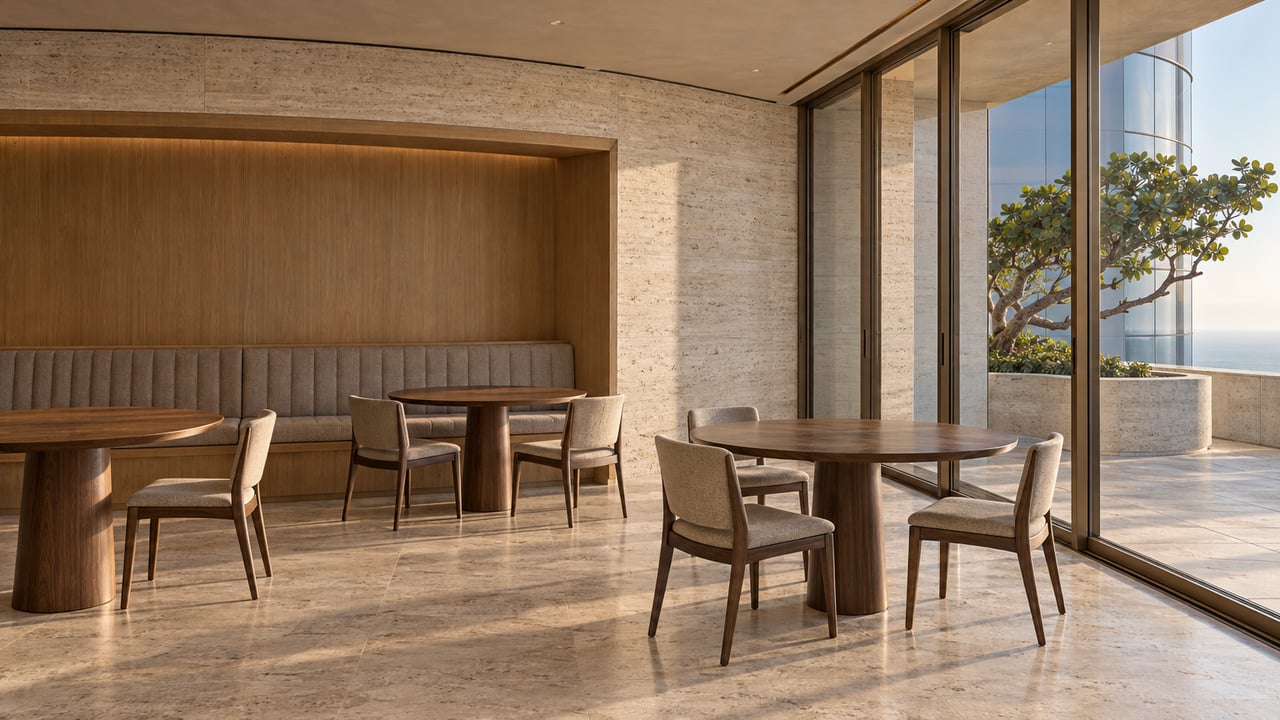
Seia opened March 14 on the 54th and 55th floors of 830 Brickell, a partnership between OKO Group, the tower's developer, and the Bastion Collection, the group behind Michelin-starred Le Jardinier and South Florida's only two-Michelin-starred restaurant, L'Atelier de Joël Robuchon. Executive chef Alessandro Morrone, trained in Naples and seasoned in kitchens across Italy, New York, and Miami, runs a menu built around seasonal, share-driven Italian cooking.
The building's floor plan tells you why it's structured the way it is. The 54th floor is open to the public. The 55th, Seia Club, is not. It runs as a members-only space with its own terrace and a calendar of programming that never reaches the public dining room below. The building's office tenants get a client-dinner venue without leaving the block, and Seia never has to compete for a passerby's attention, because there's no sidewalk fifty-four floors up. A restaurant at street level has to convince someone walking by to come in. A restaurant inside an office tower only has to be good enough that the people already there don't want to leave for dinner somewhere else.
Brickell Key's dining problem started when La Mar closed as the Mandarin Oriental Miami prepared for its 2025 redevelopment, leaving the island without an obvious answer to where you'd go for dinner without crossing the bridge into Brickell proper. That gap lasted the better part of a year.
The old hotel itself came down on April 12, an 8:30 a.m. controlled implosion that Miami officials called the city's largest demolition in more than a decade. The 23-story tower and its adjacent six-story parking structure fell in about 20 seconds, clearing the 500 Brickell Key Drive site for The Residences at Mandarin Oriental, a two-tower project designed by architecture firm KPF. Swire Properties, the same developer behind Brickell City Centre, expects groundbreaking later this year and completion in 2030.
Three days before the implosion, on April 9, The Mexican opened at 601 Brickell Key Drive, an expansion of a Dallas restaurant that earned a Prix Versailles distinction as one of the World's Most Beautiful Restaurants. Owner Roberto González Alcalá, who grew up in Monterrey, built the Miami location on the same waterfront the old hotel once anchored: more than 10,000 square feet, seating for over 330 guests across indoor rooms, private spaces, and terraces that stretch toward Biscayne Bay. Interior architect Paulina Morán sourced much of the art, furniture, and materials from Monterrey for a room built around a tequila gallery and limestone archways facing the water.
The Mexican didn't have to win over a street. It's the one full-service restaurant on a private island where residents were already the built-in audience, and it opened three days before the old anchor across the water disappeared.
Brickell now carries some of the highest restaurant rents in Florida, and the numbers behind two recent street-level moves make the point plainly. As The Real Deal reported, in late July, Japanese restaurant Omakai relocated from the Solaris condo tower to a 2,500-square-foot space at 1108 South Miami Avenue at a rent of roughly $120 per square foot. That same month, and around the same block, restaurant Negroni filed for Chapter 11 bankruptcy, listing about $224,000 in rent claims owed to the citizenM hotel for the 4,200-square-foot space it occupies.
Against that backdrop, the fight over Allen Morris Brickell Park makes more sense. The 7,780-square-foot park at 25 Southeast 10th Street, near Mary Brickell Village, is one of the last patches of green space and mature tree canopy left in the neighborhood's commercial core. It was deeded to the City of Miami in 1974 by Allen Morris Sr. with a clause that would return ownership to the family if the land was ever used for anything other than a public park. That clause became the subject of nearly a decade of litigation after the developer sued the city in 2014, arguing the since-shuttered restaurant Perricone's Marketplace & Cafe had already violated those deed restrictions by operating on park land.
The developer now holds title to the parcel, and in August, Axios Miami and The Real Deal reported that Allen Morris Companies is partnering with chef Stefano Secchi, known for Michelin-starred Rezdôra and Massara in Manhattan, on a 3,000-square-foot restaurant called Gavina. The City of Miami approved a temporary use permit in April capping occupancy at 132 people including staff, good for one year and renewable annually up to three years before any further extension would need city commission approval. The developer's attorney has described the restaurant as an early step rather than a final plan for the parcel, with a longer-term decision on the land still years away. Community members have raised concerns about losing one of the few remaining green spaces in the corridor, and a petition opposing the project has circulated since the plan became public.
A rooftop restaurant inside an already-built office tower never has to clear that kind of hurdle. The tower exists, the tenants exist, and the only real estate question was which floor to build on. A restaurant on one of Brickell's last open lots has to survive a decade-old deed dispute, a temporary permit structure, and organized neighborhood pushback before a single reservation gets made.
None of this means ground-floor Brickell has stopped functioning. It means the street-level spots that are thriving right now tend to be plugged into the same kind of built-in demand that powers the tower restaurants, just without an elevator involved.
Cipriani Downtown Miami runs an 8,000-square-foot space across two levels with outdoor seating on the Miami River, built around the same Venetian flooring and handmade pasta program the Cipriani family has run for decades. CLAUDIE, a Riviera-inspired French restaurant from chef Michael Michaelidis, whose résumé includes Le Louis XV-Alain Ducasse and Joël Robuchon, keeps a lush patio and live music going nightly. MAMO, the Brickell outpost of the SoHo original founded by Mikaël Mammoliti, has carried its New York following south. Osaka, the Peruvian-Japanese Nikkei spot at 1300 Brickell Bay Drive, added a five-course Nikkei Teishoku prix fixe lunch this year to give the weekday office crowd a faster way into a menu built around tiraditos and blowtorched nigiri. Even PopUp Bagels found a home at 801 Brickell, another storefront that opens directly into a building full of people who were already going to be there anyway.
The common thread isn't the cuisine. It's proximity to a population that doesn't have to decide to visit Brickell. They already live, work, or check into a hotel there. Brickell City Centre runs on the same logic at a larger scale, pulling weekday lunch and after-work retail traffic from the office towers, hotel guests from EAST Miami, and a daytime population from its residential towers, rather than generating destination foot traffic of its own.
The newest kitchens in Brickell follow the same pattern, and the Allen Morris Brickell Park proposal shows how much more a ground-up project has to clear. In Brickell right now, the strongest position belongs to a restaurant inside a good building.
If you're watching how Brickell keeps rearranging itself, tower by tower and lease by lease, David De Leon tracks these shifts as closely as anyone working the neighborhood day to day. Reach out anytime you want a local read on what's changing next.
This article is general information, not legal, tax or financial advice. Consult a qualified professional about your situation.
Stay up to date on the latest real estate trends.
Working with the De Leon Group guarantees a seamless luxury real estate experience. With their deep market knowledge and well-honed negotiation skills, the De Leon Group ensures you secure the best possible deals while enjoying a level of professionalism and integrity that sets them apart in the industry.